On November 12, 2026, TechFlow published a translation of a Bankless analysis reporting that the MegaETH Foundation had renamed itself MEGA and committed $30 million from its treasury to develop products on the MegaETH network. Its first planned product is an AI inference marketplace, expected to launch in December 2026. The marketplace had not launched at the time of the report.
The shift comes as the network’s total value locked stood below $10 million, down from a peak above $245 million in May, according to the article. MegaETH co-founder Shuyao Kong said on X that the team needed to change course after building what she described as the fastest chain without finding product-market fit. That statement does not establish whether the planned marketplace will find demand.
The marketplace’s proposed approach
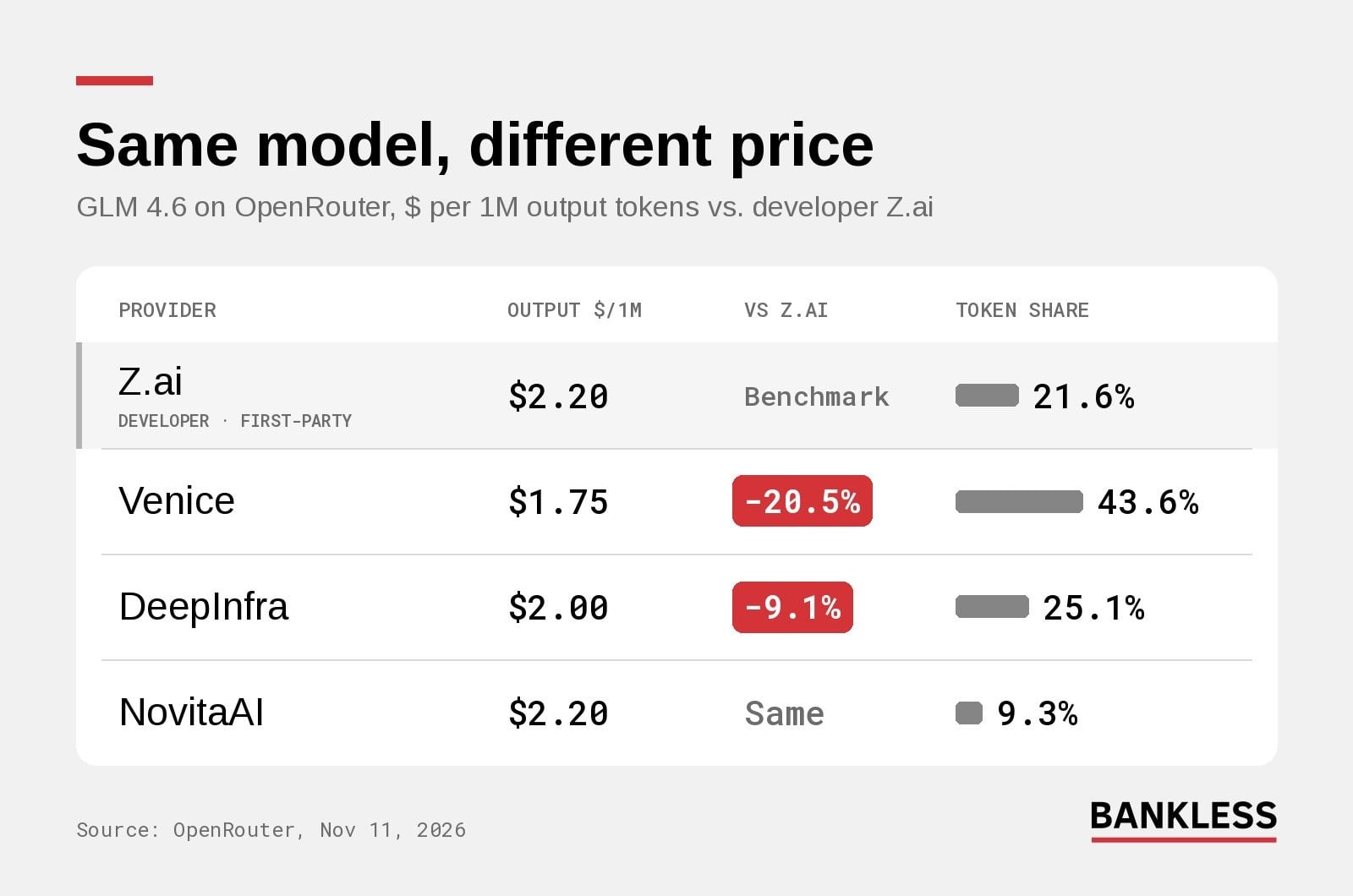
MEGA’s white paper argues that buyers may pay more to use a model through its developer rather than a cheaper third-party provider because they lack confidence in what the provider is running. The article cites an OpenRouter listing for GLM 4.6: $2.20 per million output tokens through developer Z.ai, compared with $1.75 through third-party provider Venice. MEGA proposes checks for model authenticity, privacy and safety to make providers easier to compare.
Bankless author David Christopher questions whether model verification alone will distinguish MEGA. He points to existing approaches, including model fingerprinting, trusted execution environments and cryptographic proofs. MEGA’s white paper discusses those approaches and their limitations but does not specify which, if any, the marketplace will use.
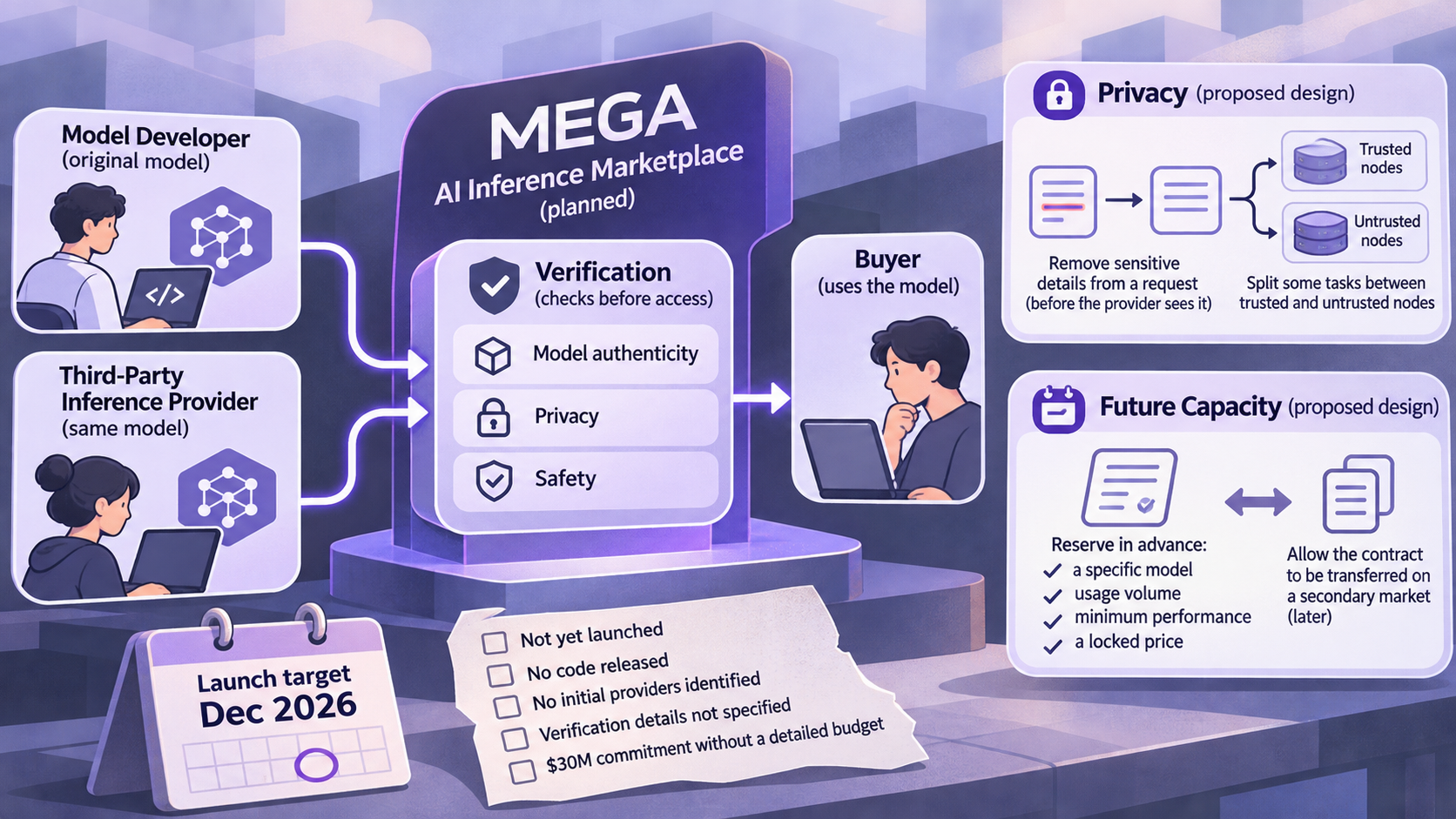
Two further ideas remain proposals rather than operating features. For privacy, MEGA describes removing sensitive details from a request before a compute provider sees it and splitting some tasks between trusted and untrusted nodes. Christopher argues that the removal step would need to happen outside MEGA’s own view—such as on a user’s device or in protected hardware—to avoid merely transferring access to the sensitive information from the provider to MEGA. The white paper does not say where that step would run.
For future capacity, the white paper envisages buyers reserving a specified model, usage volume and minimum performance for a future period at a locked price. It also proposes allowing those contracts to be transferred on a secondary market later. Neither a live contract market nor a completed transaction was reported. Christopher raises an unresolved question: why buyers would lock in a model and price months ahead when inference costs and leading models can change quickly.
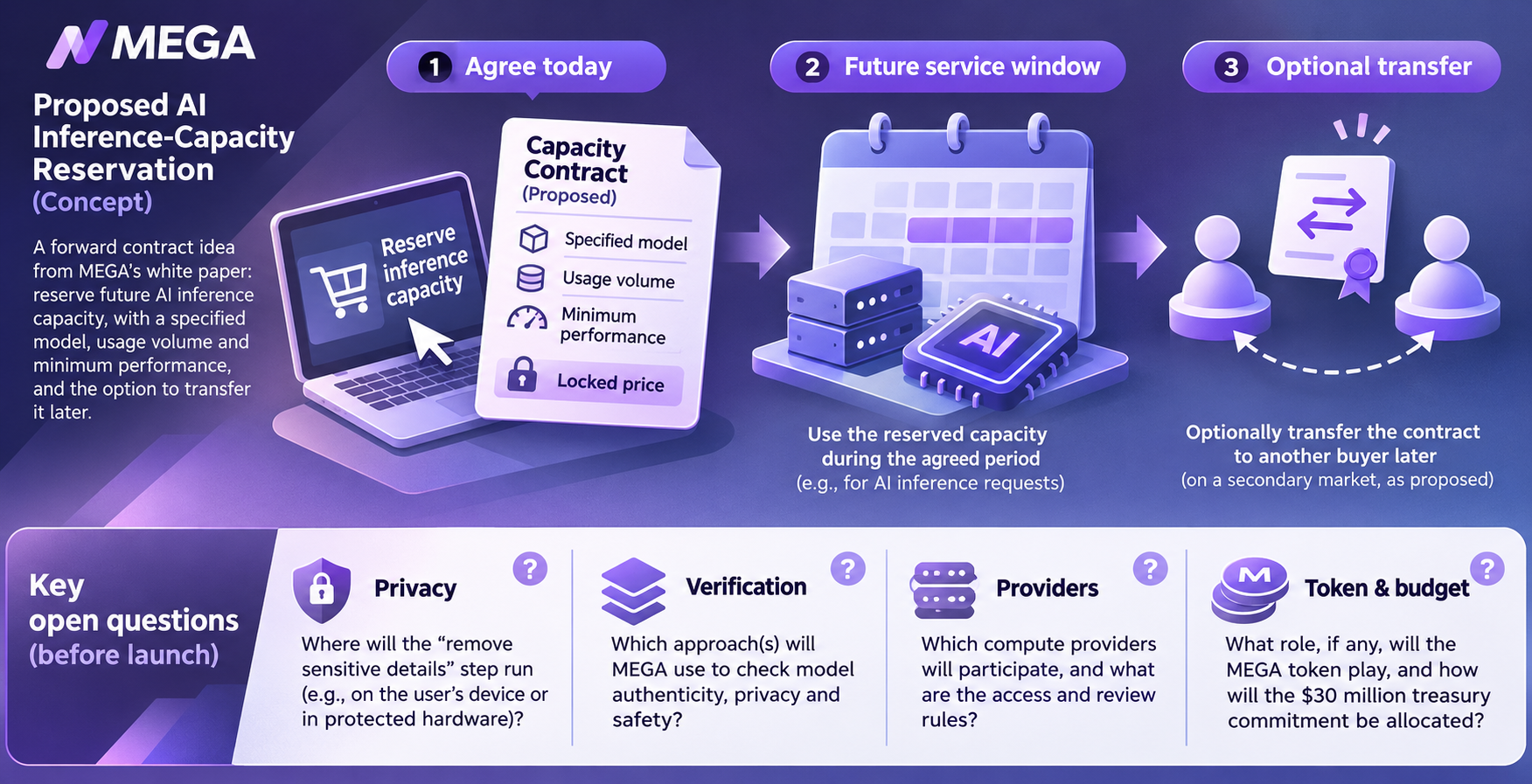
At publication, the team had not released code or identified the marketplace’s initial compute providers. The white paper also left open who would carry out verification and did not explain a role for the MEGA token. Asked about the token by The Block, Kong said the team would use opportunities that could benefit it. A detailed budget for the $30 million commitment had not been disclosed.
The December launch target may clarify how the marketplace is meant to work. For now, its privacy design, provider participation and proposed capacity contracts remain unproven.