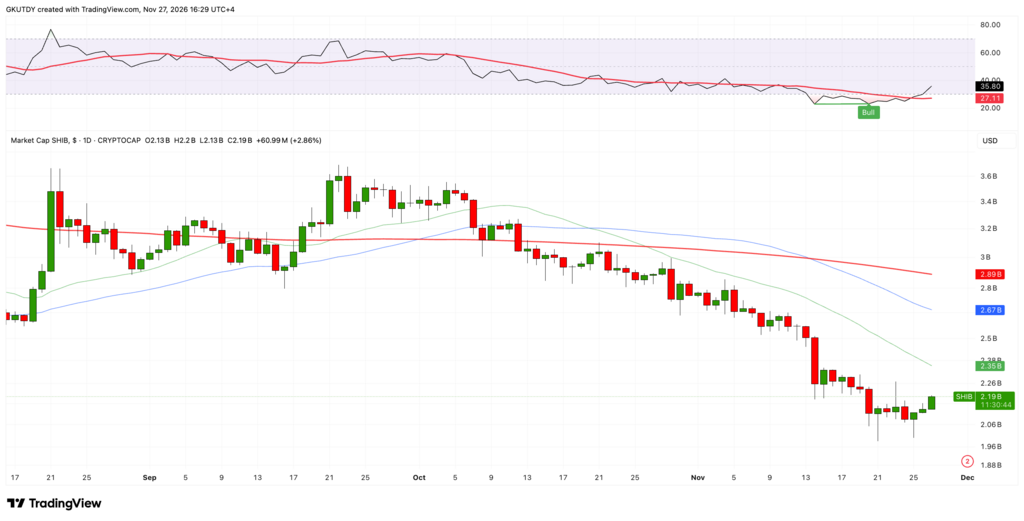
Shiba Inu (SHIB) traded at about $0.0000037 on Nov. 27, 2026, up 1.8% over 24 hours, according to TradingView. Its market capitalization recovered to $2.19 billion after briefly falling below $2 billion on Nov. 21, when the token hit $0.00000337, its lowest price since 2021. TradingView’s ranking listed SHIB at No. 34 with a market cap of $2.18 billion.
The daily chart’s first bullish relative strength index (RSI) signal since September came before the low: TradingView’s divergence tool flagged it on Nov. 20, a day before the price bottomed. The RSI had fallen below 30, a level generally considered oversold, on Nov. 14. It stayed below that threshold until the week of Nov. 27 and reached 35 that Friday.
SHIB’s market cap fell below the $2.35 billion and $2.67 billion moving averages in October. On Nov. 27, it remained roughly $500 million below the $2.67 billion average. That gap was a comparison with past valuations, not a forecast of a Christmas rally. A third moving average stood at $2.89 billion.
Separately, Etherscan recorded more than 1.7 million SHIB holders on Ethereum on Nov. 17. CryptoQuant data showed that around 312 billion SHIB left crypto exchanges in mid-November.
November and December returns
SHIB was down 20.6% for November as of Nov. 27, according to CryptoRank, with the month due to close on Nov. 30. The token had lost value in six of the first 11 months of 2026, including the incomplete November. Its past November returns included losses of 24.8% in 2022 and 16.2% in 2025, and gains of 6.6% in 2023 and 48.8% in 2024. CryptoRank put the median November return at −18.4% and the average at −6%.
Of the five Decembers from 2021 through 2025, only December 2023 ended in a gain, at 24.6%. SHIB fell 29.5% in December 2021, 13.5% in 2022, 21% in 2024 and 17.6% in 2025. The median December return was −17.6%, and the average was −11.4%, according to CryptoRank. The first of those losses followed SHIB’s record price of $0.00008845 on Oct. 28, 2021. On Nov. 27, 2026, the token still traded more than 95% below that high.