Published November 26, 2026, at 16:52:32 (UTC+08:00).
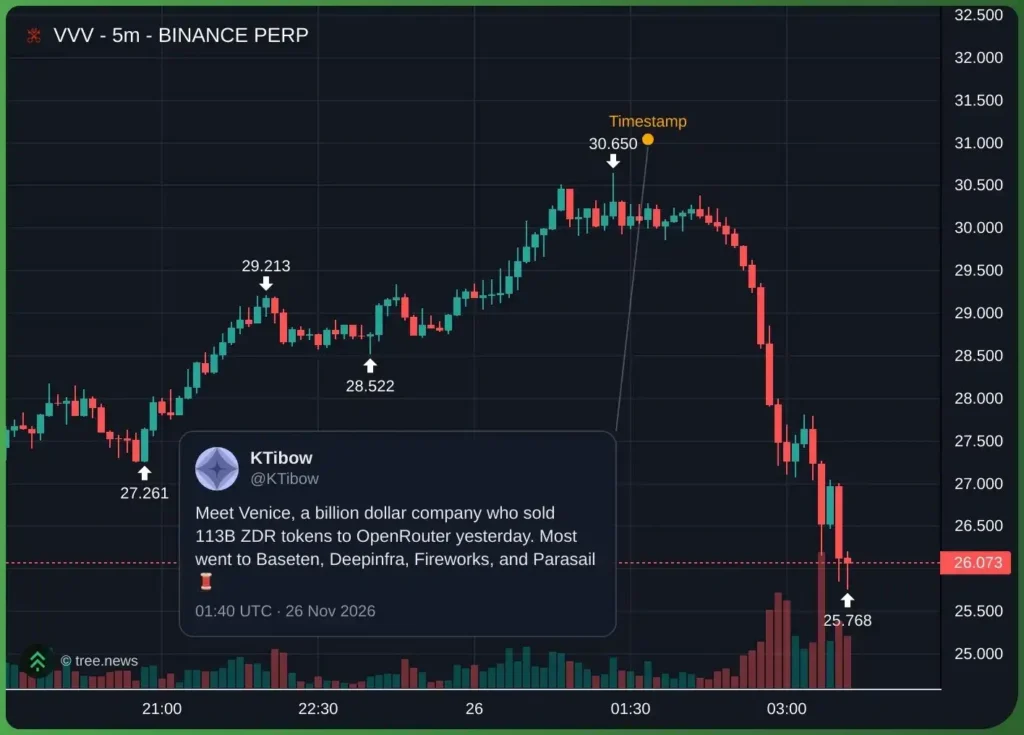
Venice founder Erik Voorhees acknowledged that some pages describing the AI platform’s models as self-hosted needed updating after developer KTibow questioned who processes users’ chats. In a November 26 thread, KTibow reported finding evidence of outside providers in tests of 14 of 18 models. Venice’s VVV token fell about 15% that day, briefly dropping from above $30 to around $25.80 after gaining roughly 33% over the preceding week.
Who can read a Venice chat?
KTibow sent image links to models and checked which servers fetched them. For 14 models, the requests came from outside providers, including Baseten and DeepInfra. KTibow argued that Venice had not clearly disclosed which companies could see prompts. Voorhees said Venice had added partners as it grew and that their contracts allowed them to use prompts only to generate the requested response, without retaining either the prompt or the answer.
That promise not to retain a conversation differs from a technical safeguard that prevents an operator from reading it. Venice offers four modes with different protections:
- Anonymous mode: The model provider can read the prompt, but Venice does not pass along the user’s account identity.
- Standard private mode: Venice or a partner processes the prompt under a commitment not to store the conversation.
- Trusted execution environment (TEE): The model runs in a hardware-isolated environment designed to prevent server operators from viewing content during processing.
- End-to-end encryption: The user’s device encrypts the message. Venice forwards the ciphertext, and the message is decrypted only inside a verified, isolated environment.
KTibow also questioned whether an intermediary could recover past conversations in some older encrypted workflows. Voorhees said no one had demonstrated such an attack and asked researchers to submit any specific vulnerability to the relevant Phala or NEAR teams. Dragonfly investor Tom Schmidt criticized the thread for not distinguishing between the four modes.
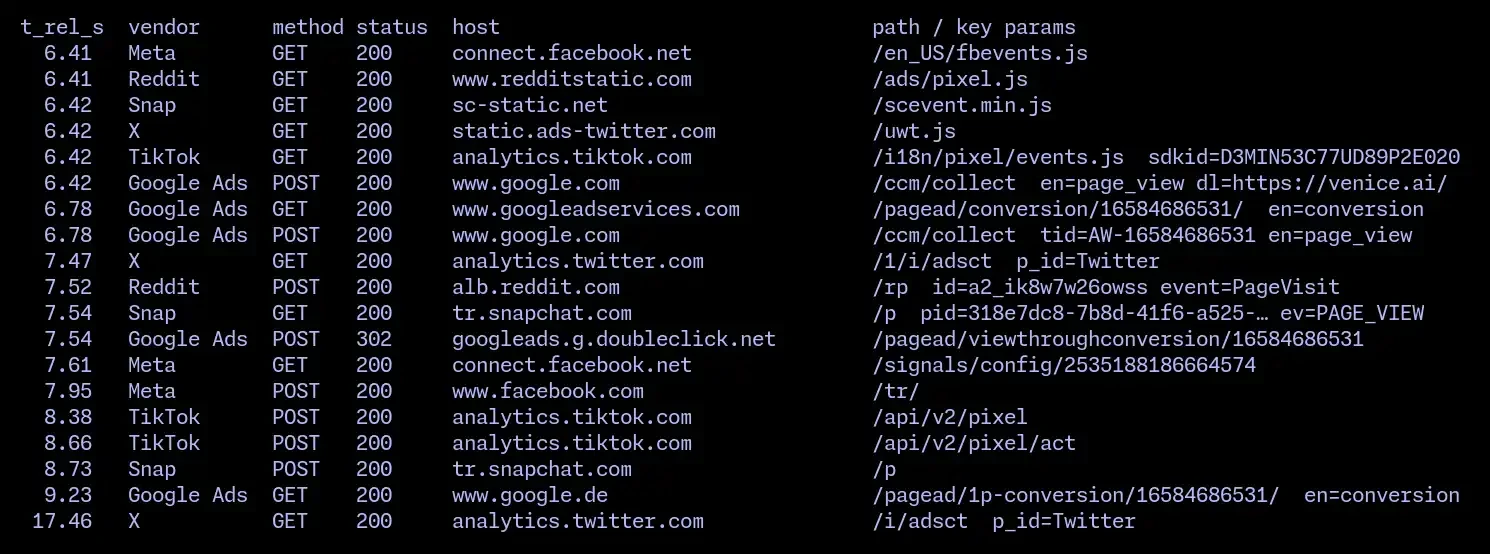
Separately, KTibow showed records of Venice’s homepage sending tracking requests to Meta, Google and TikTok. Those records concerned visits to the homepage, not the contents of chats.
How the AI service connects to VVV
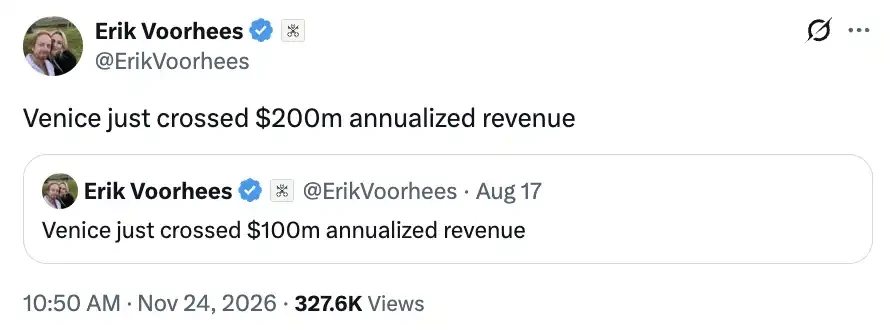
Venice gives consumers access to multiple AI models and lets developers use them through an API. In May, Delphi Digital co-founder Yan Liberman tracked integrations including OpenRouter, Fleek and Brave Leo and estimated Venice’s annualized revenue at about $60 million. Voorhees announced that annualized revenue had reached $100 million on August 17 and exceeded $200 million on November 23. Those figures describe a revenue run rate, not revenue collected over a full year.
Developers can secure ongoing API access by staking VVV, locking the resulting sVVV to mint DIEM, and staking DIEM. Each staked DIEM provides $1 in daily API credit. To recover the locked sVVV, a minter must burn the corresponding amount of DIEM. In July, Venice also committed to using 5% of API credit sales to buy back and burn VVV.
Venice added another use for VVV when it launched Minds on November 17. Creators can list task-specific AI agents on the Mind Market and charge a markup. They receive 90% of that markup in credits; the platform uses the remaining 10% to buy back VVV. Users can also burn tokens to improve an agent’s ranking.
Wallet activity does not establish a sale
Lookonchain reported that a wallet it suspected was linked to Voorhees transferred 81,463 VVV, worth about $2.25 million at the time, to Coinbase. The wallet still had about 675,000 VVV staked when Lookonchain checked. The transfer established neither that Voorhees controlled the wallet nor that the tokens were sold.
Two other large wallets had requested withdrawals from staking before KTibow published the thread. A wallet beginning with 0x331c requested to unstake about 200,000 VVV on November 23, and one beginning with 0x6776 requested to unstake about 500,000 VVV on November 24. Neither request was evidence of a completed sale.