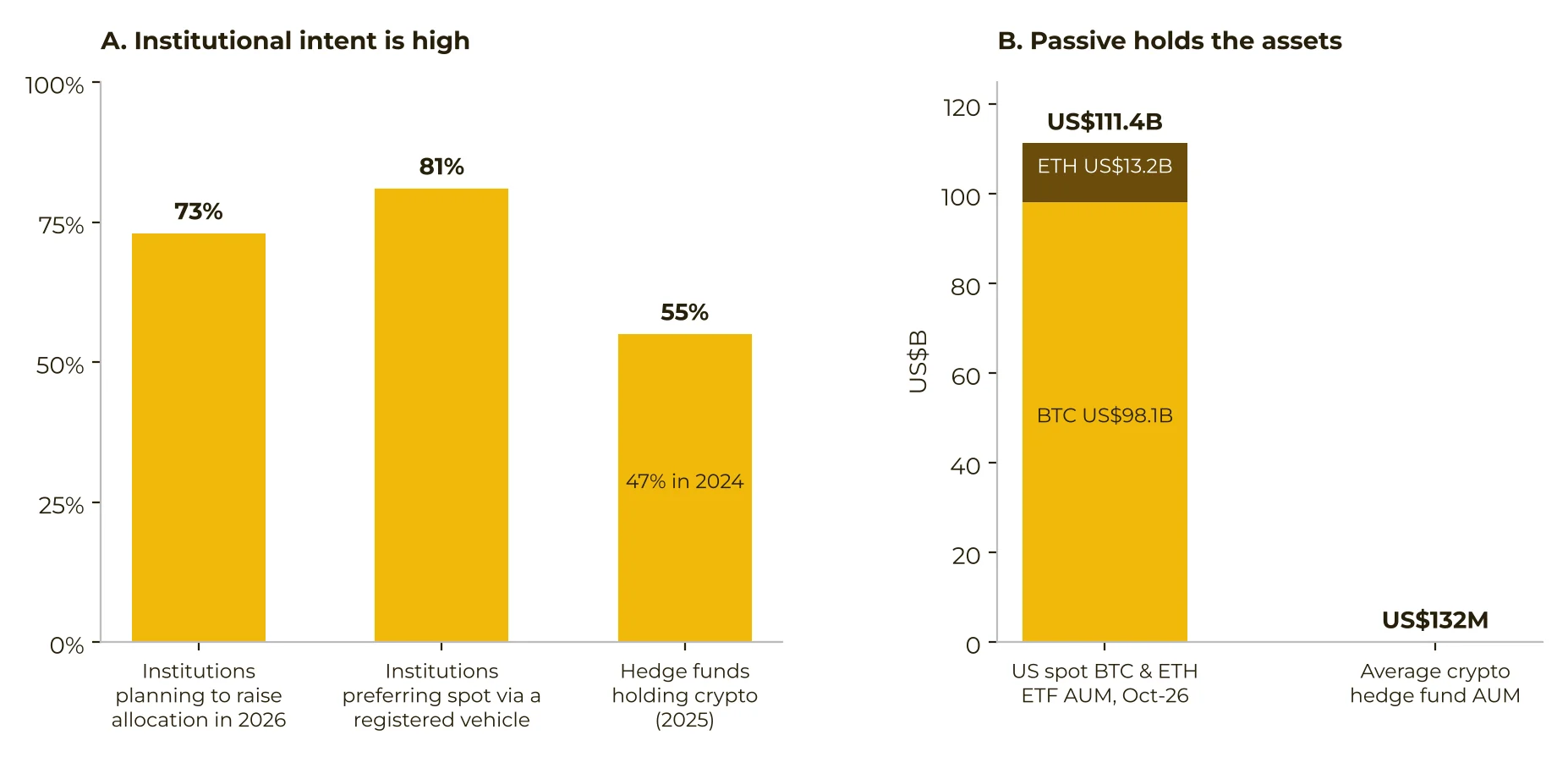
A PANews article published on November 11, 2026, at 20:29 UTC+8, carried a Binance Research note by Kim Lim and Jasper Jin, compiled by TechFlow. Using a Capital Connect snapshot through October 31, 2026, the authors said U.S. spot Bitcoin and Ethereum ETFs held about $111 billion combined, while crypto hedge funds averaged $132 million and 91% managed less than $1 billion.
They wrote that institutional money had entered crypto, but active strategies had not scaled. In their view, the constraint was not investment skill. It was the lack of an institutional distribution layer and of trusted data for checking managers. They said that reading still held in a month when Bitcoin fell 7.2%.
Passive products took most of the stated demand
Binance Research cited a 2026 EY-Parthenon and Coinbase survey in which 73% of institutions said they planned to raise digital-asset allocations that year. An AIMA and PwC report found that 55% of traditional hedge funds held crypto assets, up from 47% in 2024. Among institutions surveyed, 81% preferred spot exposure through registered, compliant products.
The authors said the gap reflected market infrastructure, not a shortage of managers. ETFs, they wrote, package custody, audit, daily net-asset-value pricing, and reporting that institutions already know. Active crypto strategies had not offered the same degree of institutional integration.
Size of positions pointed the same way. Among traditional hedge funds that held crypto, more than half allocated less than 2% of total assets, while 60% of institutions planned to lift exposure above 2% within a year. Binance Research treated that as interest limited by existing investment infrastructure, not by a lack of intent.
A chart on high allocation intent versus flows into passive tools listed the March 2026 EY-Parthenon and Coinbase institutional survey, the AIMA and PwC 2025 global crypto hedge fund report, a State Street digital-asset survey from October 2025, SoSoValue, and Binance Research, as of October 31, 2026. The article text does not quote a separate State Street figure.
The missing layer was discovery and verification
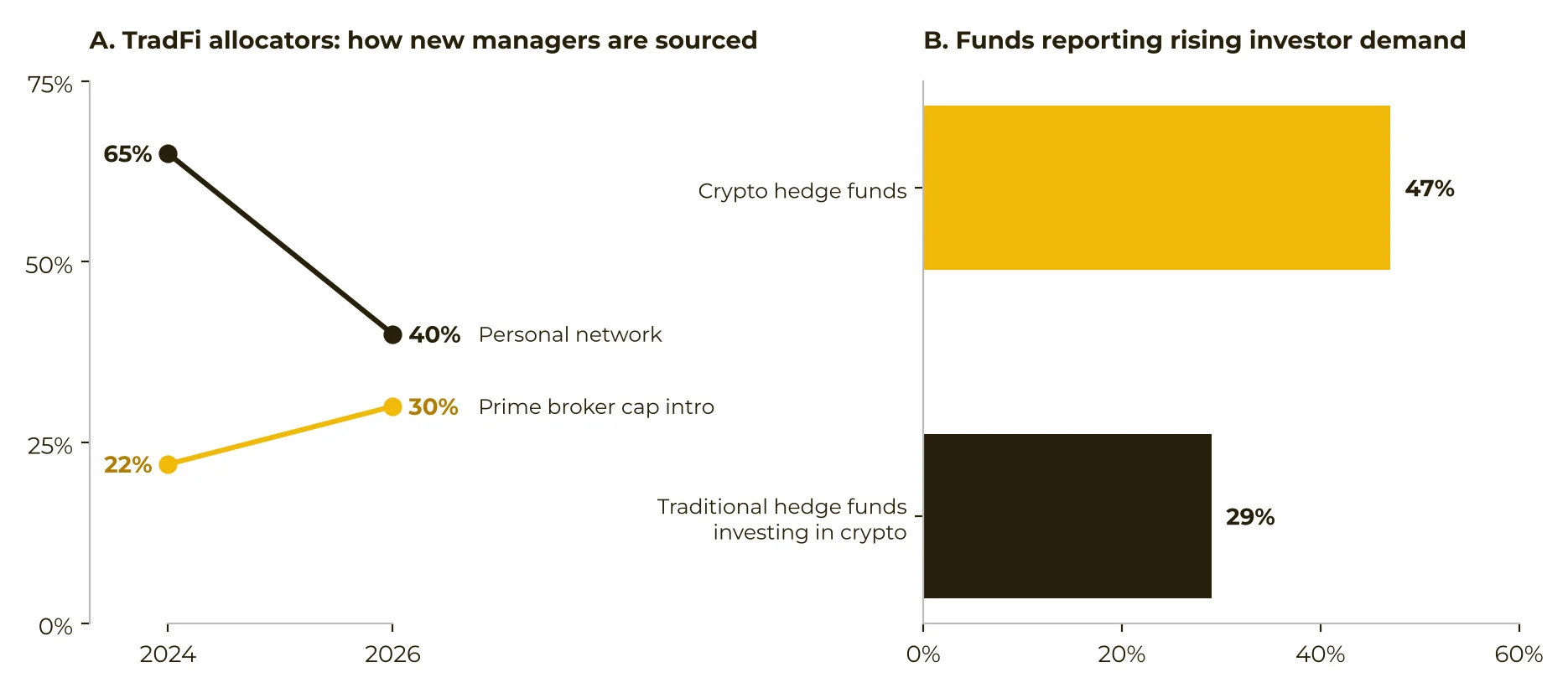
If the bottleneck were talent, the authors wrote, the market would tend to clear it. They instead described discovery and verification. An AIMA and Marex survey found allocators’ reliance on personal networks fell from 65% in 2024 to 40% in 2026, while prime-broker capital introduction rose from 22% to 30%.
Crypto, they said, still lacked a matching standard channel. Capital still depended on Telegram groups, offline conferences, and personal referrals. Without a common disclosure and benchmark framework, investors could not compare managers on the same terms, and institutions had difficulty checking audited financials, custody arrangements, and service-provider credentials.
The friction constrained both sides. Forty-seven percent of crypto hedge funds said investor demand was rising, against 29% of traditional hedge funds involved in crypto. Family offices and high-net-worth individuals remained the main backers. Only one-fifth of crypto hedge funds listed pensions, endowments, or sovereign wealth funds as a primary investor type, up from one-ninth a year earlier.
A related chart cited the AIMA and Marex 2026 emerging-manager survey, the AIMA and PwC 2025 report, and Binance Research, as of October 31, 2026.
Fund count and assets on Capital Connect pointed opposite ways
Capital Connect is described as Binance’s regulated platform for finding and allocating to crypto funds, built to fill that distribution gap. Strategies on it must be disclosed, and results are measured on one standard. This update extended the data through October 31, 2026, and added direct interviews with platform allocators and fund managers for the first time.
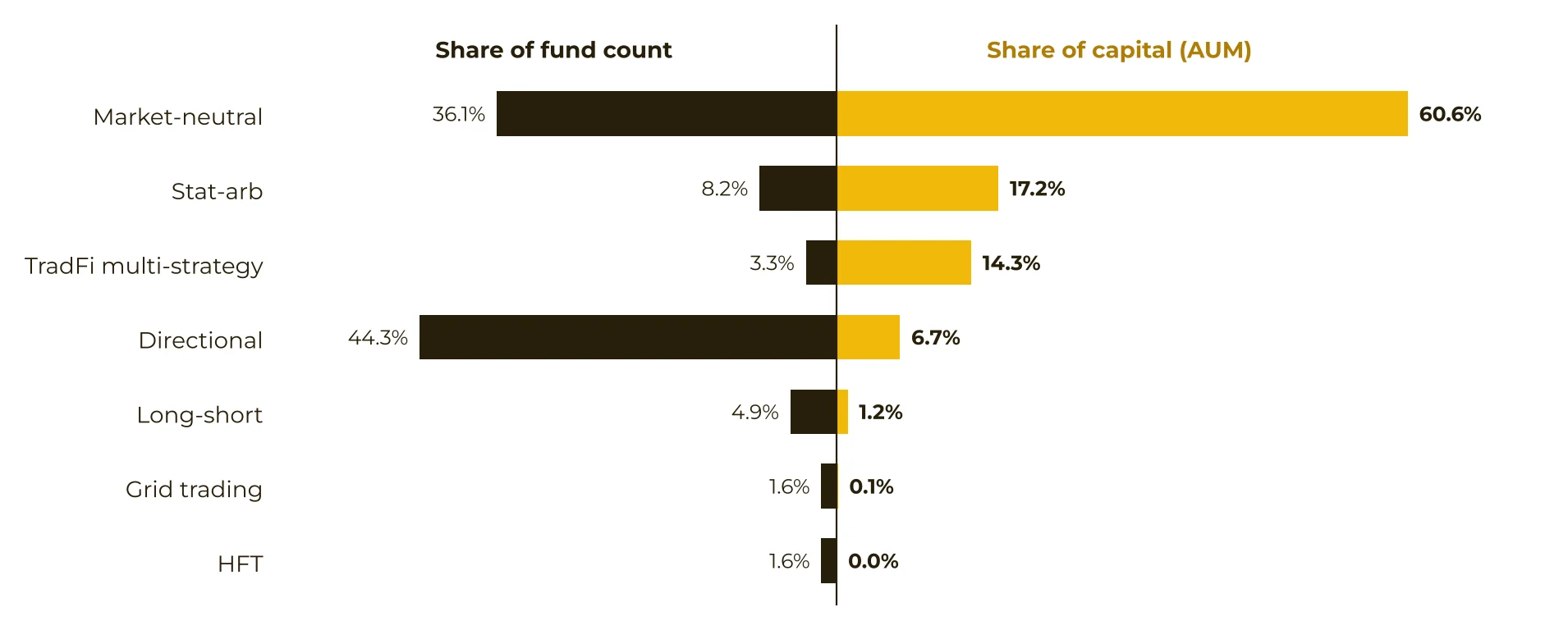
Neutral-strategy funds were under half of the fund count but held 92.1% of platform capital. Directional strategies were the largest group by number, at 44.3% of funds, but only 6.7% of assets. Market-neutral, statistical-arbitrage, and traditional-finance-style multi-strategy funds together held that 92.1%; multi-strategy funds alone were 14.3%.
The average ticket in neutral strategies was about 11 times the directional average. Binance Research said the pattern showed allocator preference, not simply which category had more funds.
Market-neutral investor participation had risen for two consecutive months and was up 30% since May. Statistical-arbitrage participation more than doubled over the same period and held steady through October. The authors said many long-tail managers still offered directional products while institutional capital concentrated in hedged strategies. A discovery layer, they wrote, does not create that preference; it makes it visible.
Two mandate styles were both tested in October
Two allocation patterns were growing, and October’s decline tested them differently.
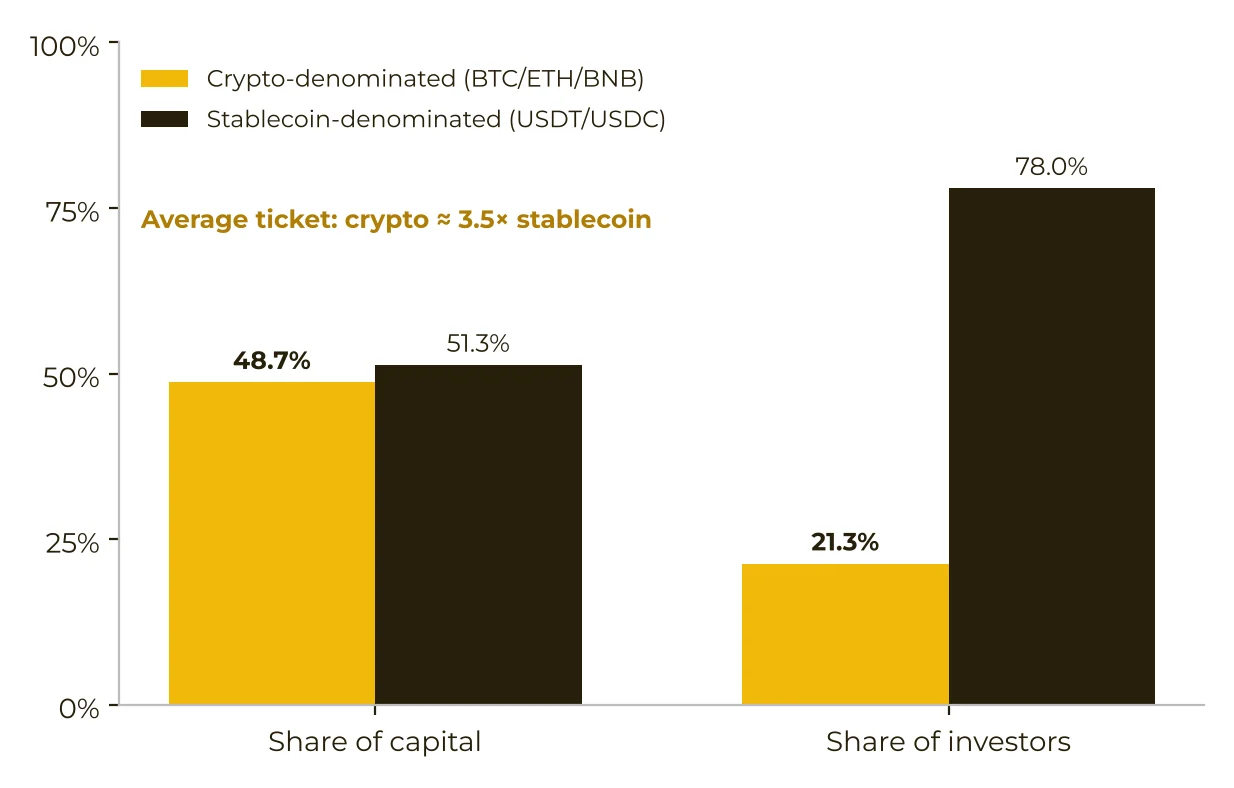
In the crypto-native pattern, 48.7% of platform capital was in funds denominated in BTC, ETH, or BNB. Those funds drew about one-fifth of investors, but their average ticket was about 3.5 times that of stablecoin funds, the largest average subscription size on the platform. Allocators kept the underlying-asset exposure and outsourced the hedge. In October, coin-denominated physical holdings stayed stable; the decline in dollar-measured assets mainly tracked the Bitcoin price.
In the convergent pattern, traditional multi-strategy funds were still the third-largest strategy by assets, at 14.3%. Investor participation there fell 14% month over month in October, from 21 people to 18. Binance Research read that as a maturing market rather than a reversal: institutions would use structures familiar from traditional finance, but they kept screening, and some reduced exposure even when returns were steady.
Directional participation returned, with a much wider results gap
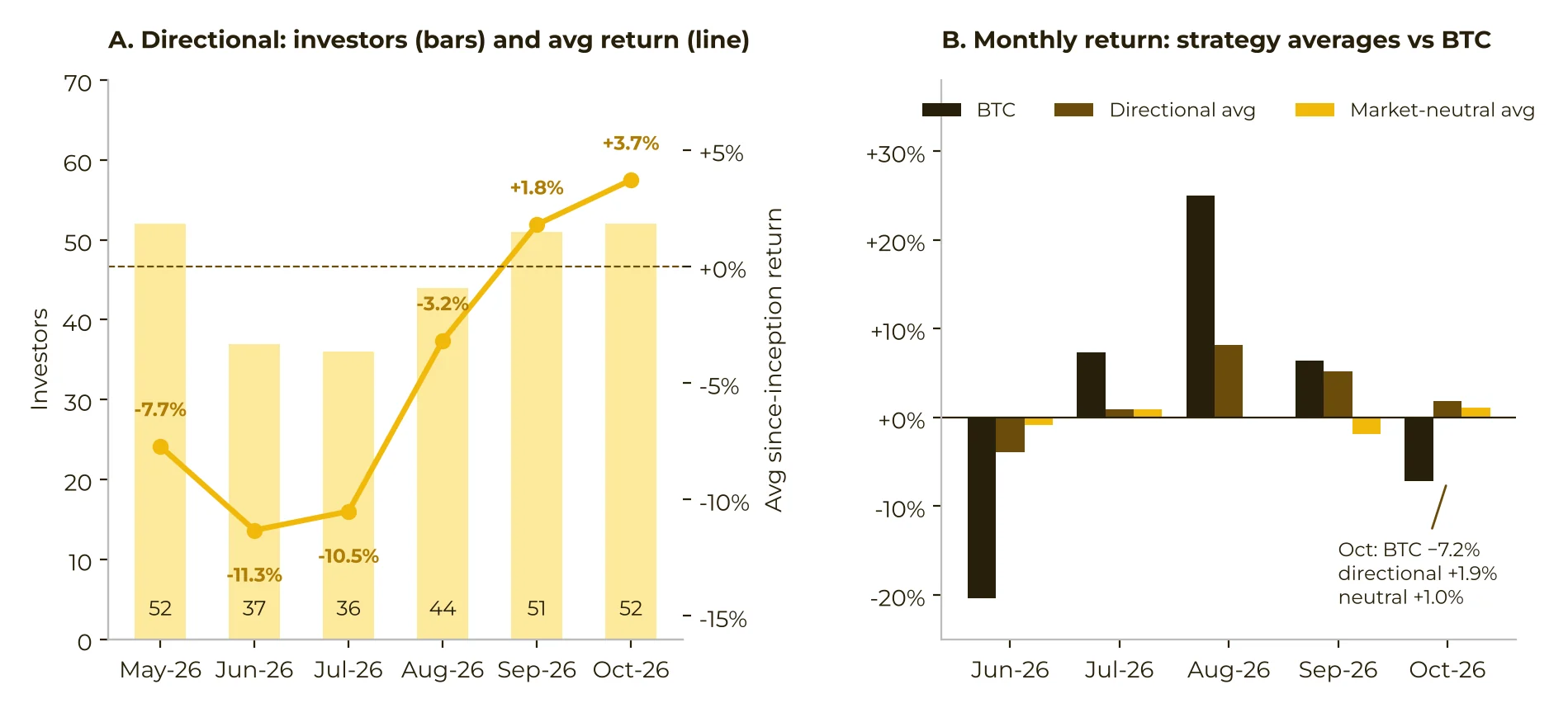
Directional participation was rebuilding. After returns bottomed in June, the investor count in the sample fell to 36 in July, then recovered to 52 in October, the May level. The average since-inception return of directional funds improved from −11% in June to +3.7% in October.
October was described as the first real test of that recovery. Bitcoin fell 7.2%, while directional funds still averaged +1.9% for the month and market-neutral funds averaged +1.0%. The chart treats strategy returns as a simple average of fund net asset values, and the Bitcoin series is Binance BTC/USDT. Interviews showed the same behavior: allocators usually cut directional exposure in drawdowns and added again after volatility and liquidity stabilized.
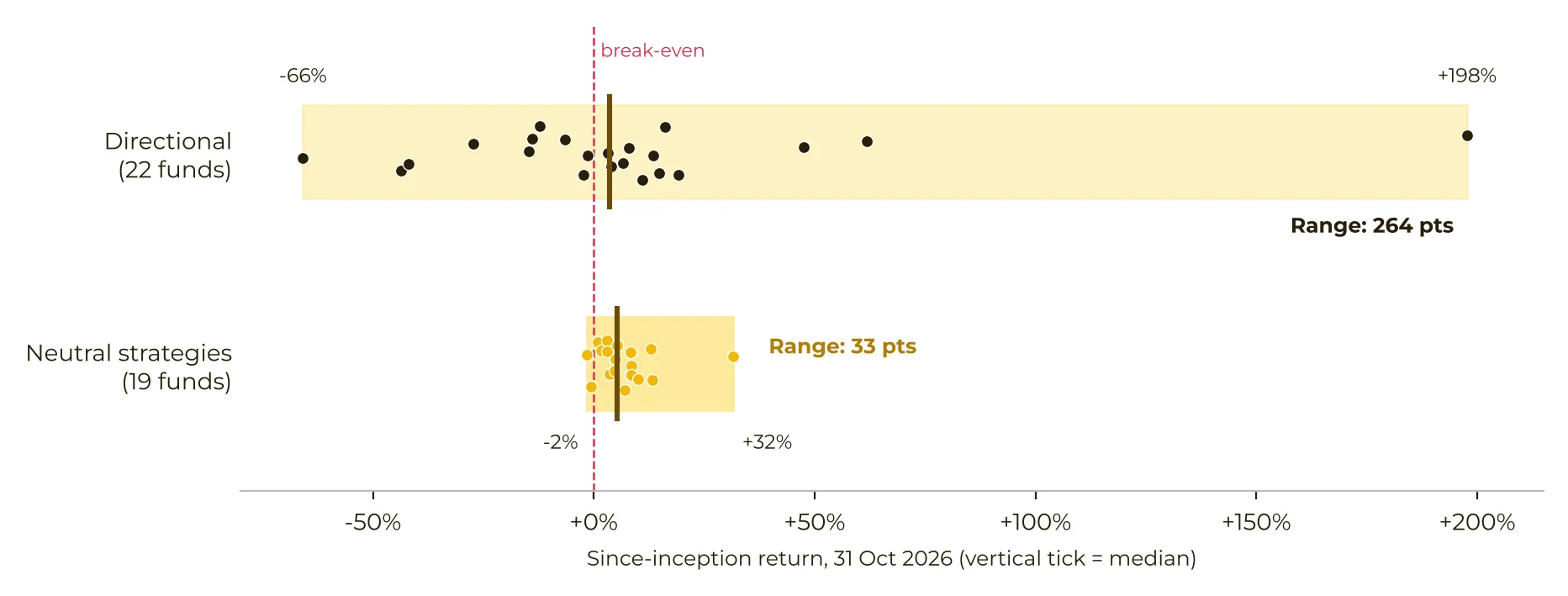
Directional results stayed widely spread. The gap between the best and worst directional funds was about eight times the gap among neutral strategies. The median was around +4%, and only 55% of directional funds were positive, compared with nine in ten neutral funds. That dispersion chart excluded dormant funds and funds managing less than $1,000; neutral there included market-neutral, statistical arbitrage, and traditional multi-strategy funds.
The top quarter of directional funds had averaged +69% since inception. Allocators told the researchers they would still pay for alpha at that level if drawdowns stayed controlled.
Allocators ranked asset safety ahead of the track record
Binance Research interviewed Capital Connect allocators and the trading teams running funds between October 29 and November 1, 2026.
Every allocator interviewed said verified data from inside an exchange would significantly strengthen due diligence. Eighty percent ranked asset safety first, above historical performance and institutional reputation. In judging managers, they looked more at drawdown control than at high headline returns.
Managers said the real fundraising obstacle was the cost of trust, not returns that failed to stand out. Track records were hard to cross-check, and KYC, anti-money-laundering, and counterparty compliance reviews slowed raising money, so most capital still depended on personal referrals. After listing on the platform, some managers said they could reach a wider investor set, compliant institutions, and pools assembled from smaller tickets.
The authors said both sides sent the same signal: verifiability opens trust, and operating infrastructure can widen the channel. Hedge-style strategies still dominated, coin-denominated mandates still produced the largest tickets, and directional capital was still waiting for a clearer recovery signal.
What the October snapshot does not establish
The note does not show active crypto funds closing the scale gap with spot ETFs. Pensions, endowments, and sovereign wealth funds were a primary investor type for only about one in five crypto hedge funds. Directional investor counts were back to the May level, but October was one month, the published returns are simple averages, and the spread between directional winners and losers remained far wider than in neutral strategies.
Binance Research said the report is not a forecast, investment advice, or an offer to buy or sell any product or strategy. Views were current as of the dates above and could change. The firm said its figures come from proprietary and non-proprietary sources it considered reliable, may be incomplete, and are not guaranteed accurate, and that forward-looking statements may not be realized.
Original article, published November 11, 2026, 20:29 UTC+8: PANews.